Calcolatore LDL: How to Use an Online Tool and Check Your Result

Typing three numbers into a box feels almost too easy. Yet a calcolatore LDL hides real math behind that friendly screen. Knowing what happens inside helps you spot odd answers. It also keeps you from trusting a typo. This guide walks you through the whole process. You will learn which data to enter and which formula the tool likely uses. You will also learn how to sanity-check the output. Let’s turn a simple widget into a smart habit.
Che cos’è un calcolatore LDL?
An LDL calculator is a small program that estimates LDL cholesterol from other lab values. You supply total cholesterol, HDL, and triglycerides. The tool applies a formula and returns an estimate.
Most versions are free. Many run right in your browser. Hospitals and health sites often provide them. A typical LDL online calculator takes seconds to finish. However, the output is an estimate and not a direct measurement. Keep that distinction in mind as you read on.
Quali dati bisogna inserire?
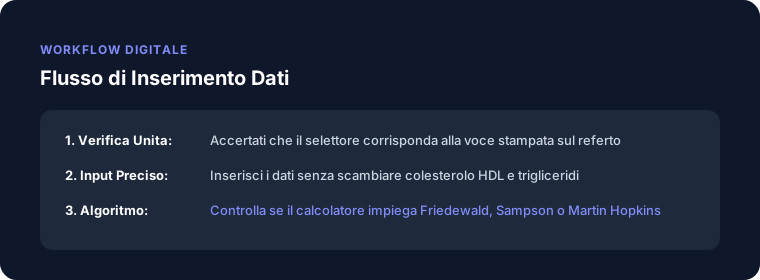
Gather three numbers from your report. Total cholesterol comes first. HDL follows. Triglycerides come last. Some tools also ask whether you fasted.
Then pick the correct unit. The two common choices are mg/dL and mmol/L. A wrong selection ruins everything. For example, entering 5.2 in a mg/dL field tells the tool you have almost no cholesterol. Read the labels twice before you click. Accurate inputs produce accurate outputs. Garbage in, garbage out, as programmers like to say.
Come utilizzare il calcolatore passo dopo passo
Follow this routine each time. Open the tool and select your unit. Type total cholesterol into the first field. Enter HDL in the second. Add triglycerides in the third. Press calculate.
Next, read the result and note its unit. Compare the figure with your lab’s printed value, if one exists. Finally, save the date and numbers in a notebook or app. Over time, those entries reveal trends. A single reading rarely matters as much as the direction across several tests.
Quale formula può essere utilizzata?
Most tools rely on the Friedewald equation. In mg/dL it reads: LDL = total − HDL − triglycerides ÷ 5. Developers like it for its simplicity.
Newer options exist. The LDL Martin Hopkins calculator uses a flexible divisor based on your non-HDL and triglyceride values. It tends to beat Friedewald when triglycerides are elevated. The Sampson equation is another modern alternative. Check the tool’s help page to see which method it uses. Transparency signals a trustworthy site. Hidden formulas deserve skepticism.
Come controllare che le unità siano corrette
Units cause more errors than anything else. Fortunately, conversion is straightforward. Divide cholesterol values in mg/dL by 38.67 to reach mmol/L. Divide triglycerides in mg/dL by 88.57.
| Measure | mg/dL to mmol/L |
|---|---|
| Total, HDL, LDL | ÷ 38.67 |
| Triglycerides | ÷ 88.57 |
A good LDL calculator mg dl and its LDL calculator mmol l cousin should agree after conversion. Test it yourself. Enter the same values both ways and compare. Matching answers confirm the tool works properly.
Cosa fare se il risultato sembra insolito
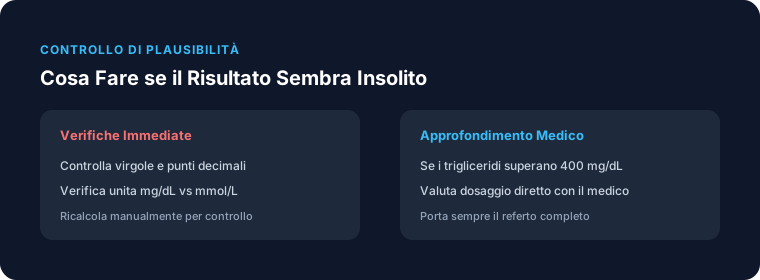
Sometimes the screen shows something strange. Maybe LDL appears negative. Maybe it exceeds your total cholesterol. Neither can happen in real life.
Stay calm. Start by rechecking every digit. A misplaced decimal is the usual culprit. Then confirm the unit setting. If everything looks right, run the numbers by hand. Subtract HDL and one fifth of triglycerides from the total. Still odd? Contact your lab or doctor. Unusual values may signal a lab issue or a medical condition that deserves attention.
Quando i trigliceridi possono influenzare la stima
Triglycerides drive the formula’s biggest weakness. The method assumes a fixed link between triglycerides and VLDL cholesterol. That link weakens as triglycerides climb. Above 400 mg/dL, the estimate becomes unreliable. Many tools simply refuse to calculate.
An LDL calculator triglycerides field deserves careful attention. Even moderate elevations can push the Friedewald result too low. Non-fasting samples add another wrinkle. In these cases, a Martin-Hopkins estimate or a direct lab measurement works better. Ask your doctor which option suits you.
Calcolatore LDL e risultati del laboratorio
Your lab may report a calculated LDL already. Others measure it directly. Both appear on official paperwork. Small gaps between your online estimate and the printed value are normal. A difference of a few mg/dL rarely matters.
Large gaps need investigation. They may stem from different formulas or rounding choices. Sometimes the lab used a direct assay. Ask staff which method they applied. The American Heart Association offers plain explanations of cholesterol testing. Always treat the laboratory result as the reference point.
Perché un calcolatore non sostituisce il referto medico
A calculator crunches numbers. It cannot examine you. It does not know your blood pressure, your family history, or your medications. Doctors weigh all of these factors.
Furthermore, a number alone never labels you “healthy” or “dangerous.” The ISS lists 100 mg/dL as a desirable LDL ceiling in general. Individual goals can differ. Someone with diabetes or heart disease may need a lower target. Use the tool for curiosity and preparation. Then discuss the results with a professional who sees the full picture.
Conclusione: usare correttamente un calcolatore LDL
A calcolatore LDL works best in careful hands. Enter clean data. Choose the right unit. Understand the formula behind the screen. Then double-check any strange output